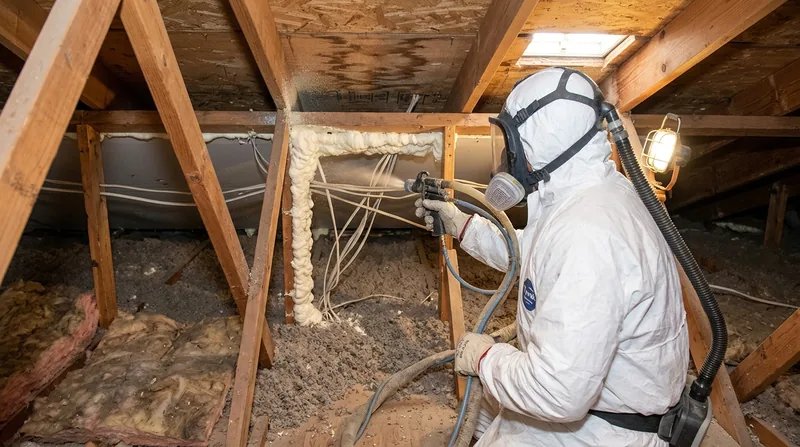




Air leakage through top plates, rim joists, and wall penetrations costs Denver homeowners thousands of dollars a year in wasted heating and cooling. In climate zone 5B, where cold snaps push temperatures from 60 degrees to below zero in hours and chinook winds can swing 40 degrees in an afternoon, air sealing in Denver is not a luxury, it is the fastest payback on an energy retrofit. We seal the gaps that fiberglass misses: the band joists in brick bungalows across Park Hill and Washington Park, the top plates in mid-century ranches stretching from Wheat Ridge to Englewood, and the penetrations around electrical outlets and mechanical chases in newer homes across Arapahoe and Douglas counties. Unlike blown-in insulation, spray foam adheres to the substrate and expands to fill every void, stopping drafts before they reach your living space. The result is a measurable drop in utility bills, fewer cold spots, and a home that holds its temperature through the worst Front Range weather.
Why Air Sealing Matters in Denver's Climate
Denver sits in a high-altitude, semi-arid climate where the real enemy is air infiltration, not moisture. The Front Range experiences wild temperature swings: a January morning at 20 degrees followed by a 50-degree afternoon, then back below freezing at night. These swings create pressure differentials that drive cold air through every unsealed gap in your home's envelope. Older homes, the brick bungalows built before 1950, the ranches thrown up in the 1960s and 1970s, even some of the townhomes in newer subdivisions, were built to different standards than today's energy code. Rim joists in basements, top plates where the walls meet the attic, and unsealed penetrations for ductwork and plumbing are the primary leak points.
- Rim and band joists in uninsulated basements allow cold air to infiltrate directly into the first floor, creating cold spots and forcing your furnace to run longer.
- Top plates and wall cavities in attics allow warm air to escape in winter and hot air to seep down in summer, especially in vented attics where the temperature can exceed 140 degrees.
- Electrical outlets, plumbing penetrations, and mechanical chases in exterior walls act as highways for air movement if not sealed during construction or retrofit.
- Chinook winds and cold fronts create pressure imbalances that exploit every unsealed gap, making air sealing the single most cost-effective energy measure in Denver homes.
Sealing these gaps with spray foam stops the draft before it enters the conditioned space. Unlike caulk or weatherstripping, which degrade over time, closed-cell spray foam creates a permanent air barrier that also adds R-value and resists moisture.
Key info: A typical Denver home with an uninsulated rim joist and a leaky top plate loses 25 to 40 percent of its heated air to infiltration. Air sealing alone can cut that loss by half without touching the attic insulation. See the rim joist and band joist spray foam page for basement-specific details.
For more information on how air leakage is measured and why it matters, the U.S. Department of Energy's air sealing guide provides standards that apply across all climate zones.
How We Seal Air Leaks in Denver Homes: Our Process
Air sealing is a detective job. We start by identifying where air is actually moving, top plates, rim joists, penetrations, and gaps in the existing insulation. We then seal those gaps with spray foam, paying attention to the substrate condition, the thickness required by code, and the ventilation needed during cure. The goal is a continuous air barrier that stops infiltration without trapping moisture or creating other problems downstream.
- We perform a visual inspection of the attic, basement, and rim joist areas to identify air leakage paths and assess substrate condition.
- We discuss your priorities: is the focus the attic, the basement rim joist, or specific problem areas like a cold bedroom or drafty living room?
- We prepare the area by clearing insulation away from the zones to be sealed and confirming that the substrate is dry and clean.
- We apply spray foam to the identified gaps, paying attention to the manufacturer's ratio, drum temperature, and pass thickness to ensure proper cure.
- We provide mechanical ventilation during the cure period (typically 24 to 48 hours) and advise on re-entry timing before the area is safe for insulation or drywall.
- We deliver a written estimate with R-value and thickness specifications so you know exactly what you are paying for.
Every job is different. A small rim joist seal in a Littleton basement might take a few hours and cost far less than a full attic and top-plate seal in a sprawling Highlands Ranch ranch home. That is why we measure on site and give you a concrete number before we start.
Local example: A 1970s ranch in Wheat Ridge with an uninsulated rim joist, a leaky top plate, and settled fiberglass in the attic typically needs rim joist sealing (1 to 2 inches of closed-cell foam along the perimeter), top plate sealing (1 to 2 inches along the full length), and spot sealing around mechanical penetrations. The total cost runs $1,200 to $2,000 depending on square footage and access. A brick bungalow in Park Hill with a similar scope but tighter attic access may run higher due to the work involved.
For attic-specific sealing and insulation, see our attic spray foam insulation page.
Air Sealing Methods and Techniques
| Approach | Description | Best for |
|---|---|---|
| Closed-Cell Spray Foam (1.5 to 2 lb/cu ft) | High-density foam that expands and hardens to R-6.5 per inch, creating both an air barrier and moisture barrier. Applied in thin passes (0.5 to 1 inch per pass) to avoid thermal shock and ensure proper cure. | Rim joists, top plates, and penetrations where space is tight and moisture control is a concern. Most common choice for Denver air sealing. |
| Open-Cell Spray Foam (0.5 lb/cu ft) | Lower-density foam that expands more aggressively and achieves R-3.6 per inch. Softer and easier to cut or trim, but vapor-permeable and not suitable for moisture-prone areas. | Interior wall cavities and attics where air sealing is the goal and moisture is not a concern. Cheaper than closed-cell but less durable outdoors or in damp basements. |
| Spot Sealing with Caulk or Sealant | Polyurethane or silicone caulk for small gaps and cracks where spray foam would be overkill. Does not add R-value but stops air movement. | Small penetrations, electrical outlets, and gaps around trim. Used as a supplement to spray foam, not a replacement for larger leaks. |
| Injection Foam for Closed Walls | Low-pressure foam injected into existing wall cavities through small holes, then trimmed flush. Adds insulation and seals air leaks without opening the wall. | Retrofitting pre-1980 homes with hollow walls. Combines air sealing and insulation in one step. See our wall and injection foam page for details. |
The choice of method depends on the location, the size of the gap, the substrate condition, and whether moisture is a factor. Closed-cell foam is the most common choice for Denver air sealing because it handles the wide temperature swings and low humidity of the Front Range, but open-cell foam is a cost-effective option for interior attic cavities where moisture is not a concern.
Air Sealing Cost in Denver: What to Expect
Air sealing costs vary widely depending on the scope, the location of the leaks, and the substrate condition. A small rim joist seal in a finished basement costs less than a full attic and top-plate seal in a large home. We provide written estimates with R-value and thickness specifications so you know exactly what you are paying for and can compare apples to apples with other contractors.
Most rim joist and band joist sealing jobs in Denver start at around $650 to $900 for a standard basement perimeter. Top-plate sealing in an attic typically runs $1,200 to $2,500 depending on the square footage and ease of access. Combination jobs (rim joist plus top plate plus penetrations) often cost $2,000 to $4,000. Very large homes, complex attics with many obstacles, or difficult access can push costs higher, and those jobs are estimated on site after we see the conditions.
The biggest factors that move the cost are the linear feet of rim joist or top plate to seal, the thickness of foam required by code or best practice, the condition of the existing insulation (settled versus intact), and how easily we can access the work area. A ranch home in Arvada with a full basement and an easy attic might cost less than a split-level in Littleton where the attic is cramped and the rim joist is partially buried behind stored items.
We also offer detailed pricing guidance on our pricing page, which breaks down the typical costs for different scopes and locations. The key is to get estimates from at least two contractors so you can see how they measure the job and what they include in the price. A price far below market with no written specs and no mention of R-value and thickness is a red flag.
Air Sealing Near Me: What Denver Homeowners Should Know When Hiring
Hiring a spray foam contractor for air sealing is a straightforward decision if you know what to look for. The contractor should be fully insured, should provide a written estimate with R-value and thickness specs, should answer questions about ventilation and cure time without hesitation, and should be reachable after the job is done if you have questions or concerns. We operate across Denver, Arapahoe, and Douglas counties, and we are based locally so you can reach us by phone at (720) 235-5710 if you need to.
- Verify that the contractor is fully insured and can provide a certificate of insurance on request, covering both liability and completed operations.
- Request a written estimate that includes the R-value per inch, the thickness per pass, the total board feet, and the labor and material breakdown.
- Ask about ventilation during cure and the re-entry window (typically 24 to 48 hours) before the area can be re-insulated or closed up.
- Check references from recent jobs in your area, particularly homes with similar construction (brick bungalow, mid-century ranch, townhome, etc.).
- Understand that permitting requirements vary by city and neighborhood. Some areas require a permit for attic work; others do not. Ask the contractor to confirm what applies at your address and to help you navigate it.
- If you have an HOA, confirm that exterior work (such as rim joist or band joist sealing on the outside of the house) complies with architectural rules. Interior basement work usually does not require approval.
We pride ourselves on honest guidance. If your attic insulation is sound and your air leaks are limited to the rim joist, we will tell you to seal the rim joist and skip the attic. If you have a small, simple job, we will not oversell you a full spray foam retrofit. That straightforward approach is what sets a local, independent contractor apart from both rig-and-run crews and national franchises. To discuss your specific situation and get a free, no-obligation estimate, contact us today.
Air Sealing in Denver: Pricing Guide
| Service | Price | Details |
|---|---|---|
| Rim Joist and Band Joist Sealing | Starting at $650 | Closed-cell foam seal around basement perimeter, includes inspection and written estimate with R-value and thickness |
| Top Plate Sealing (Attic) | Starting at $1,200 | Closed-cell foam applied to top plate where walls meet attic, cost varies with linear feet and attic access difficulty |
| Combination Rim Joist and Top Plate Seal | Starting at $2,000 | Full basement perimeter plus attic top plate in one job, includes mechanical ventilation during cure and 24 to 48 hour re-entry window |
| Large or Complex Air Sealing Job | On estimate | Full attic retrofit with multiple penetrations, crawl space sealing, or difficult access requires on-site inspection and written quote |
| Travel and Mobilization | Included | No separate mileage fee or travel charge for jobs in Denver and surrounding areas including Aurora, Lakewood, Arvada, and Westminster |
| Free Estimate | No charge | Written estimate with R-value and thickness specs, response within 24 hours, call (720) 235-5710 to schedule |
Indicative pricing, the exact cost depends on square footage, finish, and site access. Free personalized estimate within 24h at (720) 235-5710.


