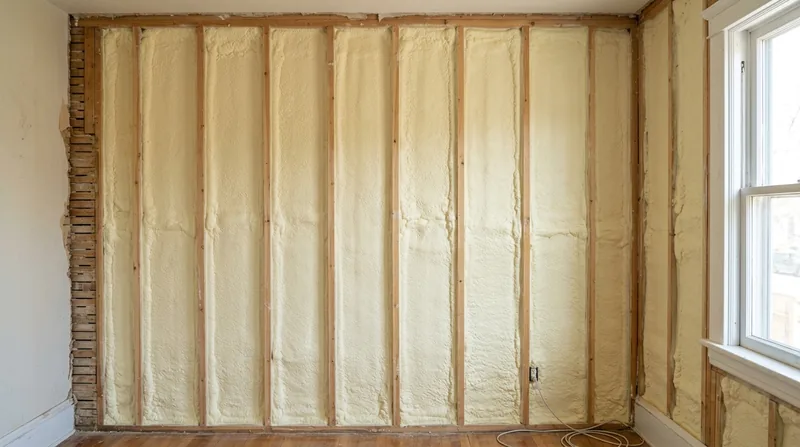




Open cell spray foam insulation in Denver fills cavities and attic rafter bays across the dry, low-humidity climate of the Front Range, cutting air leakage without the bulk of closed cell foam. Denver's brick bungalows in the Highlands, Park Hill and Washington Park, mid-century ranches across Wheat Ridge and Arvada, and newer townhomes stretching into Douglas County all sit over basements with vented attics that bake under strong sun and cool fast once it drops. The energy fight here is driven by heat loss and drafts, not moisture: uninsulated rim and band joists in the basement, old attic insulation that has settled flat, and leaky top plates and penetrations in wall cavities. Open cell foam expands to fill those gaps, seals the air leaks that matter most, and does it without the cost or density of closed cell. We have been installing spray foam insulation in the Denver metro since 2013, and we know the homes and the climate zone 5B conditions that demand a real seal. Learn more about our spray foam insulation services.
Why Open Cell Spray Foam Insulation Matters in Denver's Dry Climate
Denver's low humidity and wide day-to-night temperature swings put the stress on air leakage, not vapor diffusion. A brick bungalow in the Highlands loses heat through the rim joist and top plate long before moisture becomes the failure mode. Open cell foam seals those paths and does it in a single pass, filling stud cavities and attic rafter bays without the added cost of closed cell. The product works because it expands to conform to framing, traps air in the cell structure, and stops the convection currents that pull heat out of the house on cold nights and let hot air in during the day.
- Open cell foam expands to fill cavities in older wood-frame walls and new construction alike across Denver and surrounding areas.
- The material is applied as a liquid and cures to a soft, spongy texture that allows vapor to move through it, which is correct for a dry climate.
- Air sealing with open cell reduces drafts in attics and walls without creating a vapor barrier that can trap moisture in cold climates.
- The product costs less per board foot than closed cell foam, making it the right choice for attics and interior walls where R-value per inch is not the limiting factor.
When the goal is to stop air leakage in a vented attic or to seal wall cavities in a Park Hill or Washington Park home, open cell is often the most cost-effective path.
Key info: Denver's climate zone 5B means cold winters, warm summers, and humidity that stays low most of the year. Vapor movement is mild compared to humid climates, so open cell foam works well here. The real fight is against drafts, and that is where open cell excels.
For more detail on how spray foam compares to other approaches, see our page on closed cell spray foam insulation, which is the denser, higher-R option for spaces where condensation control or structural support matters.
How We Install Open Cell Spray Foam Insulation in Denver Attics and Walls
The installation process starts with a site assessment to identify air leakage paths, measure cavity dimensions, and confirm that the substrate is sound and dry. We then set up mechanical ventilation during application to manage fumes and ensure proper cure. The foam is sprayed at the correct ratio and drum temperature, building thickness in controlled passes so that the material expands and cures uniformly. Once cured, we verify R-value and thickness against the specification, and we observe a re-entry window of twenty-four to forty-eight hours before the space is occupied.
- We inspect the attic or wall cavity to confirm it is dry and free of active leaks before any foam is applied.
- Equipment is positioned and mechanical ventilation is set up to manage fumes during the spray and cure cycle.
- Foam is applied in controlled passes at the manufacturer's specified ratio and temperature to achieve uniform expansion and density.
- Once cured, we document the R-value and thickness of the installation and provide written specs to the homeowner.
- We observe the re-entry window and advise the homeowner on when the space is safe to occupy and use normally.
This disciplined approach is what separates a professional installation from a rushed job that leaves odor, incomplete coverage, or failed adhesion.
Example: A 1950s ranch in Wheat Ridge with a vented attic and settled fiberglass. We remove the old insulation, air seal the rim joist and top plate with open cell foam, then install new open cell at R-19 across the attic floor. The homeowner gets a written estimate with R-value and thickness before we start, and a final inspection report when we are done. Total job time is two to three days depending on attic size and access.
See our air sealing page for more on how foam fits into a complete weatherization strategy.
Open Cell Spray Foam Installation Methods and Applications
| Application | Method | Best for Denver Homes |
|---|---|---|
| Vented attic insulation | Spray applied to attic floor and rim joist, layered to specified R-value and thickness. | Older brick bungalows and ranches with settled fiberglass and air leaks at the rim and top plate. |
| Interior wall cavities | Open cell foam sprayed into stud bays from inside the home, filling cavities without demolition. | Pre-1980 wood-frame homes in Park Hill and Washington Park where exterior demolition is not an option. |
| Rim and band joist sealing | Foam applied to the rim joist and band board at the basement rim to seal the largest air leak in older homes. | Basements in Highlands and Englewood homes where the rim joist is uninsulated and exposed to the crawl space. |
| Garage ceiling and walls | Open cell foam sprayed in the garage ceiling and side walls to reduce heat loss and sound transmission. | Attached garages in newer subdivisions across Arvada and Thornton, or shops and detached structures in rural parts of Douglas County. |
Open Cell Spray Foam Insulation Cost in Denver: What to Expect
Open cell spray foam typically starts at $0.55 per board foot in the Denver metro, with the actual price driven by job size, access, substrate condition, and whether old insulation must be removed first. A straightforward attic top-up in a 1,500-square-foot home might run 2,000 to 3,000 board feet and fall in the $1,100 to $1,650 range. A full attic retrofit with removal of old fiberglass and air sealing of the rim joist will cost more because it involves additional labor and disposal. Wall cavity insulation in a pre-1980 brick home typically runs higher per board foot because the work is slower and access is tighter. The best way to understand your cost is to get two or three written estimates that specify R-value, thickness, and board footage so you can compare apples to apples.
Factors that move the price up include old insulation removal, difficult attic access (cramped spaces, low headroom, active ducts or plumbing), substrate preparation (sealing air leaks before foam is applied), and the need to work around existing mechanical systems. Factors that keep it down include a clean, dry attic with good access, a simple roof geometry, and no prior insulation to remove. Visit our pricing page for detailed ranges and to understand what is included at each level.
We provide written estimates with R-value and thickness specifications before any work begins, and we do not surprise you with add-ons. If the substrate is wet, contaminated, or actively leaking, we walk away and refer you to the right specialist, because spray foam does not fix moisture problems, it only seals air. That honesty is what saves money in the long run.
What to Look for When Hiring a Spray Foam Insulation Contractor Near Denver
A good spray foam contractor near Denver will provide a written estimate that includes R-value, thickness, and board footage, not a vague price per square foot. They will explain the difference between open cell and closed cell and tell you plainly when one is the right choice and when a cheaper option (like blown-in fiberglass) is actually the better fit. They will ask about your attic or wall condition, check for active leaks or moisture, and walk away if the substrate is not sound. They will set up mechanical ventilation during the spray and cure, and they will observe a re-entry window of twenty-four to forty-eight hours. They will carry full insurance and be reachable if questions come up after the job.
- Get at least two written estimates that specify R-value, thickness, and total board feet so you can compare real numbers.
- Ask whether the contractor removes old insulation and what that costs separately, because removal is a big part of retrofit jobs.
- Verify that the contractor is fully insured and ask to see a certificate of insurance covering the work.
- Ask about the re-entry window and the cure time before the space is occupied, and get that in writing.
- Check local permit requirements for your address, because some Denver neighborhoods and HOAs have specific rules about attic ventilation or exterior work.
- Ask for references from recent jobs in your area, and follow up with at least one to confirm the work quality and the contractor's responsiveness.
A low price with no inspection, no ventilation during cure, and a promise of immediate re-entry is the marker of a rig-and-run crew, and it is a risk you should avoid. Contact us for a free, no-obligation estimate, and we will walk you through the process and answer your questions before you commit.
Open Cell Spray Foam Insulation in Denver: Pricing Guide
| Service | Price | Details |
|---|---|---|
| Open cell attic top-up | Starting at $0.55/board ft | Spray applied to existing attic floor in vented attics; old insulation must be removed separately if present |
| Open cell wall cavity retrofit | Starting at $0.65/board ft | Interior wall insulation in pre-1980 homes without demolition; tighter access and slower application justify higher per-board-foot rate |
| Rim and band joist sealing | Starting at $0.60/board ft | Basement rim joist air sealing; small jobs but high value in stopping the largest air leak in older Denver homes |
| Insulation removal and haul-away | From $1.50/sq ft | Old fiberglass, mineral wool, or failed foam removed and disposed of; required before retrofit jobs in most attics |
| Travel | Included | No separate mileage or travel fee within Denver and surrounding metro areas |
| Free written estimate | No obligation | Response within 24 hours at (720) 235-5710; includes R-value, thickness, and board footage before you decide |
Indicative pricing, the exact cost depends on square footage, finish, and site access. Free personalized estimate within 24h at (720) 235-5710.


