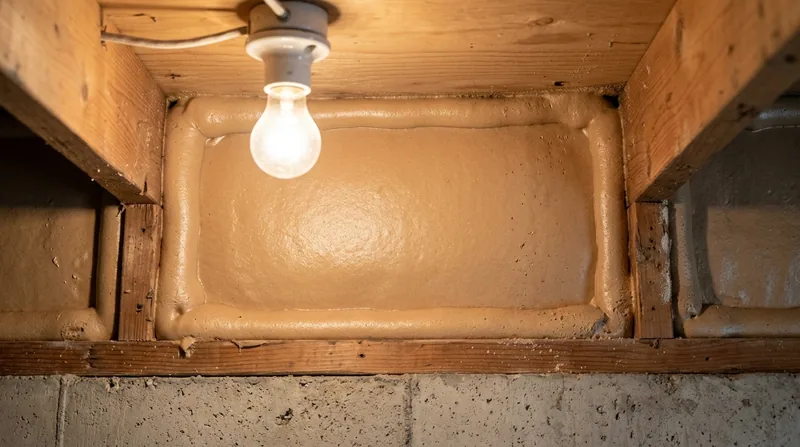




Closed cell spray foam insulation in Denver is the densest, most air-tight foam we spray. It delivers an R-value of 6.0 to 6.5 per inch, making it the right choice for rim joists, basement walls, crawl spaces and any cavity where you need both insulation and an air barrier in one pass. Denver's brick bungalows, mid-century ranches and newer townhomes all sit over basements and vented attics that leak cold air year round. The Front Range's wide day-to-night temperature swings and hard winter snaps stress every gap in an older wall cavity, and closed cell foam seals those gaps solid. We spray closed cell foam across Denver, Aurora, Lakewood, Arvada and Boulder counties to cut drafts and hold steady temperatures through the heating season.
Why Closed Cell Spray Foam Insulation Matters in Denver's Cold Snap Seasons
Denver winters push cold air through every unsealed rim joist, band joist and top plate in an older home. Closed cell foam is rigid, dense and impermeable, so it stops air infiltration dead and holds its R-value year after year without settling or degrading. Unlike blown-in fiberglass, which compresses and loses effectiveness over time, closed cell foam stays exactly where we spray it. In basements under Wheat Ridge, Englewood and Lakewood, where rim joists are often bare concrete or thin fiberglass, closed cell foam adds both insulation and a permanent air seal. The foam also resists moisture and does not absorb water, which matters in crawl spaces where humidity can spike during thaw or heavy rain.
- Closed cell foam delivers R-6 to R-6.5 per inch, the highest R-value of any spray foam product we install.
- The foam cures to a rigid, load-bearing structure that can support drywall or other finishes without additional framing.
- Closed cell foam acts as an air barrier and a vapor barrier, stopping both drafts and moisture movement through the cavity.
- The product holds up under Denver's temperature swings without cracking, shrinking or losing adhesion to the substrate.
- Once cured, closed cell foam is stable for decades and does not settle, compress or lose R-value like blown-in insulation.
These qualities make closed cell foam the standard for rim joists, basement walls, crawl spaces and any retrofit where air sealing and high R-value are both required.
Key info: A brick bungalow in the Highlands with an uninsulated rim joist and a vented basement loses heat continuously through that gap. Closed cell foam sprayed 2 inches thick on the rim and band joist raises the R-value from near zero to R-12 and eliminates the draft. The same house in Park Hill or Washington Park sees the same payoff, and the job takes one day.
For guidance on permitting and thermal barriers in your zip code, contact the City and County of Denver building department, which governs attic ventilation, ignition barriers and thermal barrier rules for spray foam insulation work.
How We Spray Closed Cell Foam: The Denver Process
Closed cell foam requires strict control of temperature, humidity, mix ratio and spray thickness. We prep the substrate, run a moisture check, and spray the foam in passes no thicker than 1.5 inches per pass to ensure it cures evenly and reaches full density. During cure, the foam releases isocyanate vapor, so we ventilate the space mechanically and ask occupants to stay out for 24 to 48 hours. Once cured, the foam is inert and safe. We then trim excess foam flush with the framing and install the required thermal and ignition barriers per code.
- We inspect the substrate for moisture, leaks or contamination and correct the problem before any foam is sprayed.
- We set up mechanical ventilation during spray and cure to control vapor and ensure safe re-entry timing.
- We spray the foam in thin, controlled passes, maintaining the manufacturer's drum temperature and mix ratio at all times.
- We trim the cured foam flush with the framing, exposing the substrate for drywall, blocking or other finishes.
- We install the required thermal barrier (typically drywall or intumescent paint) per the energy and building code in force at your address.
The entire process from prep to barrier installation takes one to three days depending on the square footage and complexity of the job.
Example: A crawl space under a ranch in Wheat Ridge measures 1,200 square feet. We spray 2 inches of closed cell foam on the rim joist, band joist and any rim blocking, plus 1.5 inches on the rim board itself. The job runs 300 to 400 board feet and takes two days. Cost is on estimate, but the homeowner gains R-12 to R-13 on the rim, eliminates the cold draft that was making the basement floor feel icy in winter, and gets a vapor barrier that keeps moisture out year round.
Learn more about how we handle rim joist and band joist spray foam across Denver and surrounding areas.
Closed Cell Spray Foam Methods and Applications
| Application | Description | Best for |
|---|---|---|
| Rim and Band Joist | 2 to 3 inches of closed cell foam sprayed on the rim, band joist and blocking above the foundation wall. | Basements in Denver, Aurora and Lakewood where cold air leaks into the basement and up through the rim into the first floor. |
| Crawl Space Walls | 1.5 to 2 inches of closed cell foam sprayed on the rim and band joist, plus the rim board and any exposed framing. | Crawl spaces under ranches in Wheat Ridge, Englewood and Arvada where moisture and cold drafts are the problem. |
| Wall Cavity Retrofit | Closed cell foam injected into the cavities of exterior walls through small holes drilled in the rim or siding. | Pre-1980 brick bungalows and masonry homes in the Highlands and Park Hill where the walls are empty and leaking cold air. |
| Sealed Attic Roof Deck | 2 to 4 inches of closed cell foam sprayed on the underside of the roof deck to create a conditioned, unvented attic. | New construction and high-performance retrofits where ductwork runs in the attic and heat gain in summer is a concern. |
| Metal Buildings and Barndominiums | Closed cell foam sprayed on the interior of the metal shell to provide insulation, air sealing and condensation control. | Metal buildings, pole barns and barndominiums across the metro where condensation on steel is the primary failure mode. |
Closed Cell Spray Foam Insulation Cost in Denver: What to Expect
Closed cell spray foam starts at approximately $1.20 to $1.50 per board foot for straightforward applications like rim joists and crawl space walls. A typical rim joist job covering 300 to 500 board feet runs between $360 and $750 in foam cost alone, plus labor. The final price depends on the size of the area, substrate condition, accessibility, and whether existing insulation must be removed first. Sealed attic roof decks and wall cavity retrofits are larger projects and typically cost more per board foot because of the complexity and the labor involved in prep and finishing.
- Rim joist and band joist jobs are the smallest ticket, typically 300 to 600 board feet and $500 to $1,200 in total cost.
- Crawl space walls run 400 to 1,200 board feet depending on the perimeter and depth, with costs between $600 and $2,000.
- Wall cavity retrofit jobs are measured by the square footage of wall and the depth of the cavity, often 500 to 2,000 board feet and $800 to $3,500.
- Sealed attic roof decks scale with the attic square footage and the desired R-value, ranging from 1,000 to 5,000 board feet and $1,500 to $8,000.
- Metal buildings and barndominiums are quoted on site because the scope varies widely by building size, wall height and existing conditions.
The best way to know your actual cost is to request a free estimate. We measure the area on site, assess the substrate, note any prep work required, and provide a written quote with R-value and thickness specifications before any work begins.
Visit our full pricing overview for more detail on what drives costs across all of our spray foam services.
What to Look for When Hiring a Closed Cell Spray Foam Contractor Near Me in Denver
Not all spray foam installers follow the same standards. Some crews spray foam in unventilated spaces without mechanical ventilation during cure, promise immediate re-entry, and provide no written estimate with R-value or thickness. These shortcuts create odor complaints, poor curing, and liability. A professional installer controls the spray environment, documents the work in writing, carries full insurance, and stands behind the installation with a workmanship warranty. Before you hire, ask the contractor for proof of insurance, a written estimate with R-value and thickness, and at least two references from recent jobs in your zip code.
- Verify that the contractor carries full insurance and can provide a certificate of insurance before work starts.
- Request a written estimate that specifies the R-value per inch, the thickness of each pass, and the total board footage.
- Ask whether the contractor will run mechanical ventilation during spray and cure, and confirm the re-entry window in writing.
- Check references from at least two jobs completed in the last 12 months in Denver, Aurora, Lakewood or your neighborhood.
- Confirm that the contractor understands local permitting rules for your city or county, and will help you navigate what applies at your address.
- Ask about the workmanship warranty and what it covers, so you know what recourse you have if the foam fails to cure properly or develops odor.
The cheapest estimate is rarely the best one. A contractor offering a price far below market, with no written specs and no ventilation plan, is cutting corners that will cost you money and headache later. Contact us for a free, no-obligation estimate and a straightforward conversation about what closed cell foam can do for your home.
Closed Cell Spray Foam Insulation in Denver: Pricing Guide
| Service | Price | Details |
|---|---|---|
| Rim Joist and Band Joist | Starting at $1.20/board ft | Typical job is 300 to 600 board feet. Substrate condition and existing insulation removal affect the final cost. |
| Crawl Space Walls | Starting at $1.20/board ft | Projects run 400 to 1,200 board feet. Perimeter length, depth and moisture prep determine total cost per job. |
| Wall Cavity Retrofit | Starting at $1.35/board ft | Injection foam into empty cavities of older masonry homes. Complexity and wall square footage drive the board foot count. |
| Sealed Attic Roof Deck | On estimate | Larger projects with variable square footage and desired R-value. On-site measurement required for accurate pricing. |
| Travel and Setup | Included | No separate mileage or travel charge for jobs within Denver and surrounding service areas. |
| Free Estimate | Free | Written estimate with R-value and thickness specs. Response within 24 hours at (720) 235-5710, no obligation to book. |
Indicative pricing, the exact cost depends on square footage, finish, and site access. Free personalized estimate within 24h at (720) 235-5710.


