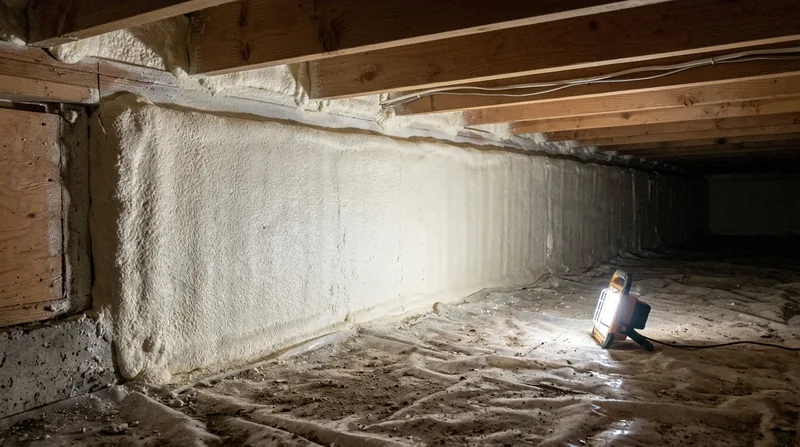




Crawl spaces in Denver-area homes sit directly over cold ground and beneath your living floor, making them a major source of drafts and heat loss during Colorado's cold winters. A crawl space spray foam insulation job seals walls, band joists, and rim areas to cut cold floors and block the winter air that flows through every gap in the foundation rim. Homes across Highlands Ranch, Lakewood, Arvada, and the older brick bungalows of Park Hill and Washington Park all suffer the same problem: uninsulated crawl space walls that let Foundation-level cold seep straight up into the first floor. Denver's climate zone 5B means wide temperature swings, strong Front Range winds, and heating bills driven by air leakage rather than missing attic insulation alone. We spray foam crawl space walls and band joists to stop that cold draft at the source, cut your utility costs, and make your floors warm again. Call us at (720) 235-5710 for a free estimate, or learn more about how air sealing complements crawl space foam work.
Why Crawl Space Insulation Matters in Denver Homes
Denver's residential stock spans brick bungalows, mid-century ranches, and newer subdivisions, and nearly all of them sit over basements or crawl spaces that sit on cold ground. A vented or uninsulated crawl space acts like a giant air leak, pulling cold air up through rim joists, through floor penetrations, and into your living space. The winter heating season in Colorado runs long and hard, and every degree you lose through the foundation rim shows up on your energy bill. Band joists and rim areas are often the last place homeowners think to insulate, but they are the fastest path for winter drafts. Sealing these areas with spray foam stops the leak and keeps warm air where it belongs.
- Spray foam on crawl space walls blocks cold air from rising into the floor above.
- Band joist and rim joist foam stops drafts that fiberglass batts cannot seal.
- Sealed crawl spaces reduce the load on your heating system all winter long.
- Foam insulation in crawl spaces also reduces moisture movement in dry climates like Denver.
The result is warmer floors, fewer drafts, and lower heating costs from November through March.
Denver example: A mid-century ranch in Wheat Ridge with an uninsulated crawl space and open rim joist loses heat all winter. Spray foam sealing the rim, band joist, and crawl space walls stops that loss and typically cuts the heating season cost by 10 to 20 percent in homes with poor basement insulation. For details on local permitting and building code compliance, refer to the City and County of Denver building department.
How We Spray Foam Crawl Spaces in Denver
Crawl space foam work starts with a site assessment to measure the space, identify the band joist and rim area, and check for moisture or existing damage. We remove any debris, verify the substrate is dry and clean, and plan the foam application. Closed cell foam is the standard for crawl spaces because it provides an air barrier, adds structural strength to rim joists, and handles the temperature swings Denver sees. We apply foam in controlled passes, maintain proper drum temperature and mix ratio, and ensure mechanical ventilation during the cure period. Most crawl space jobs take one to two days, depending on the size and layout of the space. You can find more about our closed cell spray foam process on our detailed service page.
- We assess crawl space size, access, and substrate condition before we quote.
- We clean and prepare the crawl space walls and band joist area to receive foam.
- We apply closed cell spray foam in controlled passes, maintaining proper temperature and mix.
- We ensure mechanical ventilation during cure and enforce a 24 to 48 hour re-entry window.
- We inspect the finished foam for thickness, coverage, and thermal barrier compliance per code.
The entire process is transparent and documented, with a written estimate that names the R-value and thickness you will receive.
Thornton example: A 1970s ranch with a 600-square-foot crawl space gets 2 inches of closed cell foam on all walls and the rim joist area. The crew sets up ventilation, applies foam in two passes over half a day, cures overnight with fans running, and the homeowner can re-enter the crawl space by the next afternoon. Learn more about how rim joist and band joist insulation works as part of a larger air sealing strategy.
Crawl Space Foam Methods and Approaches
| Approach | Description | Best for |
|---|---|---|
| Closed Cell Rim and Band Joist Foam | 1 to 2 inches of closed cell foam applied to the rim joist and band area, sealing the perimeter of the crawl space. | Stopping cold drafts in vented crawl spaces and adding structural strength to older rim joists. |
| Full Crawl Space Wall Closure | Closed cell foam applied to all crawl space walls from the band joist down to the floor, creating a continuous air barrier. | Homes where the crawl space sits over a significant temperature differential or where drafts are pulling cold air into the living space. |
| Rim Joist Only (Band Joist Foam) | Foam applied only to the rim joist and band area, leaving crawl space walls unfoamed but sealed at the top. | Budget-conscious retrofits where the rim is the primary draft source and crawl space walls are already partially insulated. |
| Crawl Space Foam with Vapor Barrier Prep | Substrate preparation including grading or minor moisture management before foam application, ensuring a dry surface for adhesion. | Crawl spaces with minor moisture history or uneven floors where foam adhesion is critical to long-term performance. |
Crawl Space Spray Foam Insulation Cost in Denver: What to Expect
Crawl space spray foam insulation costs in Denver typically start at $2,500 for a small rim joist and band area foam job on a modest home, and rise based on the total square footage of crawl space walls, the depth of the space, and access difficulty. A full crawl space wall closure on a 600 to 800 square foot space usually runs $4,000 to $6,500, depending on foam thickness (1 to 2 inches of closed cell) and whether existing insulation or debris must be removed first. Homes in Highlands Ranch, Centennial, and newer subdivisions often have cleaner crawl spaces and simpler access, which keeps costs lower. Older brick bungalows in Denver and Park Hill may have tighter or more complex crawl spaces, which increases labor and can move the estimate higher. The best way to know your actual cost is to get a free written estimate with R-value and thickness specs named, so you can compare apples to apples.
Several factors move the price up or down within that range. A crawl space with existing fiberglass or mineral wool that must be removed costs more because removal labor is added. Crawl spaces with standing water, active leaks, or mold staining require us to walk away until the moisture is fixed by a plumber or foundation specialist, not by us. Access matters too: if the crawl space has a tight opening, limited headroom, or obstacles that slow the crew, the labor cost increases. Foam thickness also drives price: 1 inch of closed cell is cheaper than 2 inches, but 2 inches gives you a higher R-value and better air sealing. For detailed pricing guidance and to compare options, visit our full pricing page.
Never accept a quote without R-value and thickness written down, and never accept a price based on a phone call alone. Get two or three estimates from different contractors so you can see what you are paying for. The cheapest bid is often the warning sign: if the estimate has no R-value, no thickness, and no inspection, that contractor is cutting corners and you will pay later.
Crawl Space Spray Foam Insulation Near Me: What Denver Homeowners Should Know When Hiring
Finding the right spray foam contractor for your crawl space is about verifying credentials, getting multiple estimates, and understanding what happens before the work starts. A fully insured contractor should provide proof of insurance on request and should carry liability coverage that protects you if something goes wrong. Ask for references from recent crawl space jobs in Denver, Aurora, or Lakewood, and call those homeowners to ask if the work was done on time, if the crew was professional, and if the job holds up. Get a written estimate that names the foam type, R-value per inch, total thickness, square footage of coverage, and the labor and material cost. Never hire based on price alone, and never accept a contractor who promises immediate re-entry or who skips mechanical ventilation during cure. If your home is in a master-planned community or HOA, check whether the association has rules about exterior work or foundation access, though most HOAs do not restrict crawl space insulation. Call the local building department for your city (Denver, Aurora, Lakewood, Arvada, or wherever you live) to ask whether a permit is required for crawl space foam work at your address, and make sure your contractor knows how to navigate that requirement.
- Verify that your contractor is fully insured and ask for a certificate of insurance before work begins.
- Get written estimates from at least two contractors, each with R-value, thickness, and square footage named.
- Call references from recent crawl space jobs and ask about the crew's professionalism and the job quality.
- Confirm that the contractor will use mechanical ventilation during cure and will enforce a 24 to 48 hour re-entry window.
- Check with your local building department to learn whether a permit is required for crawl space insulation at your address.
- Ask whether the contractor will remove existing insulation or debris, and whether that cost is included in the estimate or added separately.
The right contractor will answer your questions clearly, provide a detailed written estimate, and explain exactly what happens before, during, and after the foam is sprayed. If a contractor rushes you, avoids your questions, or offers a price far below market with no inspection, move on to the next one.
How to verify any contractor: Ask for proof of insurance (fully insured status), ask for a written estimate with R-value and thickness, ask for references, and call your local building department to confirm what permits or registrations apply at your address. Never assume a contractor from another state knows Denver's codes, and never sign a contract that does not name the foam type, thickness, and coverage area. We are fully insured and carry written estimates with R-value and thickness specs included. Call us at (720) 235-5710 for a free estimate, or contact us online to discuss your crawl space.
Crawl Space Spray Foam Insulation in Denver: Pricing Guide
| Service | Price | Details |
|---|---|---|
| Rim Joist and Band Joist Foam Only | Starting at $2,500 | Closed cell foam applied to the rim and band joist area, ideal for vented crawl spaces and smaller homes in Denver. |
| Full Crawl Space Wall Closure | Starting at $4,000 | Closed cell foam applied to all crawl space walls from rim to floor, cost rises with square footage and foam thickness required. |
| Crawl Space with Existing Insulation Removal | Starting at $5,500 | Full wall foam plus removal and disposal of fiberglass, mineral wool, or debris, labor and haul-away included in estimate. |
| Complex or Large Crawl Space Job | On estimate | Crawl spaces over 1,000 square feet, difficult access, or multiple sections require on-site assessment before pricing. |
| Travel and Setup | Included | No mileage fee or travel charge for jobs in Denver, Aurora, Lakewood, Arvada, and surrounding Greater Denver service area. |
| Free Written Estimate | Free | Response within 24 hours at (720) 235-5710, includes R-value and thickness specs, no obligation to book. |
Indicative pricing, the exact cost depends on square footage, finish, and site access. Free personalized estimate within 24h at (720) 235-5710.


