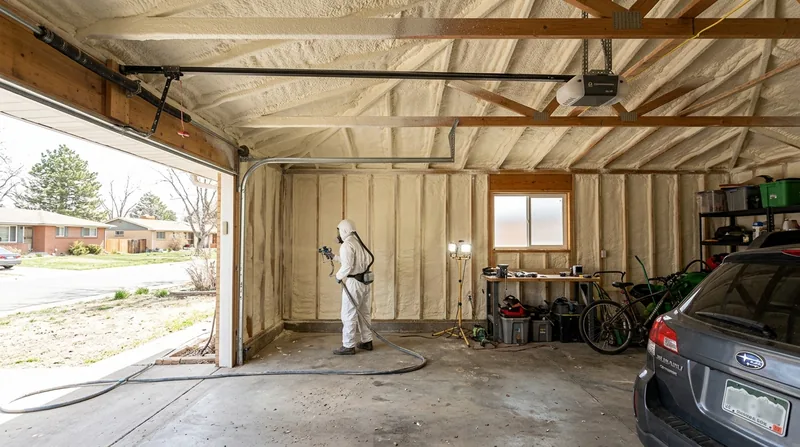




Garage spray foam insulation in Denver transforms uninsulated or poorly insulated garage spaces into comfortable, energy-efficient zones that stay warm through Front Range cold snaps and cool when summer sun bakes the metal walls. Denver's residential garages, whether attached to brick bungalows in Park Hill, mid-century ranches across Lakewood and Wheat Ridge, or newer townhomes in Highlands Ranch and Aurora, face extreme temperature swings driven by climate zone 5B winters and intense solar gain. An uninsulated garage ceiling can leak heat directly into the living space above, while exposed walls and rim joists lose warmth fast once the sun drops. We spray open cell or closed cell foam into garage walls, ceilings, and band joists across Adams, Denver and Weld counties to seal air leaks, control temperature, and make these spaces usable year-round.
Why Garage Spray Foam Insulation Matters in Denver's Climate
Denver garages sit exposed to temperature extremes that fiberglass batts and blown-in insulation cannot fully address. The problem is not just R-value; it is air leakage. Cold air infiltrates through rim joists, band board seams, and wall-to-ceiling gaps, while warm air escapes through the same paths. In winter, this means a 40-degree garage that pulls heat from the attached home. In summer, a metal-roofed garage can hit 130 degrees, radiating heat into the living space and forcing air conditioning to work harder. Spray foam seals these paths completely, stopping both conductive heat loss and air infiltration in a single pass.
- Seal air leaks in rim joists and band boards where the garage meets the foundation, stopping cold drafts from entering the home above.
- Insulate garage walls to climate zone 5B standards, maintaining stable temperatures without the temperature swings that age tools, equipment, and stored items.
- Reduce noise transmission from the garage into living spaces, especially in attached garages under bedrooms or offices.
- Prevent condensation on metal garage doors and wall studs during temperature swings, which can lead to corrosion and rust.
- Lower heating and cooling costs by reducing the load on HVAC systems that work to condition the attached home.
Closed cell foam is the standard choice for garages because it provides structural strength, handles moisture, and delivers the R-value needed to meet code in unvented spaces. Open cell foam works for detached garages where moisture risk is lower and budget is a priority.
Key info: Denver building code requires garage insulation and air sealing to be installed to the energy code in force at your address. Verify the exact R-value requirement and thermal barrier rules with the Denver or local building department before work begins. Our estimates include the R-value and thickness specification required to meet code.
For more on how spray foam seals air leaks throughout your home, see our air sealing service page.
How We Foam a Garage: Step-by-Step Process
Garage spray foam insulation starts with a clear assessment of the space: garage ceiling, walls, rim joists, and any band board areas. We determine whether closed cell or open cell foam is the right fit based on the garage type (attached or detached), existing insulation, and your goals. Once we confirm the substrate is clean and dry, we spray the foam in controlled passes, building thickness layer by layer to hit the R-value and thickness your job requires. The curing process takes 24 to 48 hours; during this time, the space must be ventilated to manage off-gassing. Once cured, the foam is trimmed flush and ready for finishing.
- Inspect the garage ceiling, walls, rim joists, and any existing insulation to assess coverage and condition.
- Determine foam type and R-value based on code requirements, space type, and your budget and goals.
- Clear the space of obstacles and protect areas outside the spray zone with plastic sheeting and drop cloths.
- Spray foam in controlled passes, maintaining proper ratio, temperature, and thickness per manufacturer specifications.
- Ventilate the garage mechanically during cure to manage odor and off-gassing; provide a 24 to 48 hour re-entry window before the space is fully occupied.
- Trim excess foam flush with framing and prepare surfaces for drywall, siding, or other finishing.
The entire process typically takes 1 to 3 days depending on garage size and complexity. We handle the spray work; finishing and drywall are your choice.
Example: A 500-square-foot attached garage in Lakewood with an uninsulated ceiling and single-stud walls gets closed cell foam sprayed to 4.5 inches (R-30). The rim joist and band board are sealed, and the garage ceiling is fully foamed. The job takes 2 days, including cure time and trim. The homeowner vents the space with box fans during the 48-hour cure window and finishes with drywall on the walls and a simple paint on the ceiling.
For details on our insulation removal process if your garage has failed or settling insulation, visit our insulation removal page.
| Approach | Description | Best for |
|---|---|---|
| Closed Cell Spray Foam | Dense, rigid foam sprayed to 4 to 6 inches, R-value 6 to 7 per inch, high compressive strength, provides air and moisture barrier. | Attached garages, metal-roofed garages, spaces exposed to temperature swings, rim and band joist sealing. |
| Open Cell Spray Foam | Softer, lower-density foam sprayed to 5 to 8 inches, R-value 3.5 to 4 per inch, sound dampening, vapor permeable, lower cost. | Detached garages, workshops, storage spaces where moisture risk is low and budget is a priority. |
| Garage Ceiling Only | Closed cell foam sprayed to ceiling framing, sealing attic air leaks and heat loss into the living space above. | Attached garages where the ceiling borders a heated room, reducing heating and cooling load on the home. |
| Full Enclosure with Rim Joist | Closed cell foam sprayed to walls, ceiling, and rim joist, creating a fully sealed, conditioned garage space. | Attached garages in Denver, Arvada, and Highlands Ranch where the garage is used as a workshop or living extension. |
Garage Spray Foam Insulation Cost in Denver: What to Expect
Garage spray foam insulation in Denver starts at $1,200 for a basic garage ceiling foam job on a smaller space. The actual cost depends on several concrete factors: the size of the garage (a 400-square-foot single-car garage costs less than a 600-square-foot two-car), the foam type (closed cell is more expensive than open cell, but delivers higher R-value and handles moisture better), the R-value and thickness your code requires, and the complexity of the space (rim joists, band boards, and existing insulation removal add to the scope). Access and condition also matter: a clean, empty garage sprays faster than one cluttered with tools and stored items. An attached garage with poor attic air sealing above the ceiling will need more foam to meet code than a detached structure.
The best way to know your cost is to get a written estimate that specifies R-value, thickness in inches, and the foam type. We provide free estimates and respond within 24 hours at (720) 235-5710. Most homeowners in the Denver metro find that the energy savings and comfort gains justify the upfront cost, especially in attached garages where the insulation reduces heating and cooling load on the home. For a detailed pricing breakdown and to see how different garage sizes and foam types compare, visit our full pricing page.
Cost example: A 550-square-foot attached garage in Westminster with an uninsulated ceiling and single-stud walls, foamed with closed cell to R-30 ceiling and R-21 walls, typically ranges from $2,200 to $3,100 depending on existing insulation and rim joist complexity. Open cell on the same space would run $1,600 to $2,400. These are estimates only; your actual cost depends on your specific garage and code requirements.
Garage Spray Foam Insulation Near Me: What Denver Homeowners Should Know When Hiring
Hiring a spray foam contractor for your garage is a straightforward process if you know what to look for. Start by asking whether the contractor is fully insured and carries liability and workers compensation coverage. Do not accept vague answers; ask for proof of insurance, and verify coverage limits are adequate for spray foam work. Get at least two written estimates that include R-value, foam thickness in inches, foam type (closed or open cell), and a breakdown of what is included. A professional estimate takes 30 to 45 minutes on site; if a contractor quotes over the phone without seeing the space, walk away. Ask for references from recent garage insulation jobs in your area, and call them to ask whether the work was clean, the cure window was respected, and re-entry timing was accurate.
- Verify the contractor is fully insured with proof of liability and workers compensation coverage before signing a contract.
- Request a written estimate that specifies R-value, foam thickness, foam type, and what is included in the price.
- Ask whether the contractor will help you navigate code requirements and permitting with the local building department at your address.
- Call references from recent garage foam jobs and ask about cleanliness, cure time management, and odor control during and after the spray.
- Confirm the contractor specifies a 24 to 48 hour re-entry window and will provide mechanical ventilation during cure.
- Check that the estimate includes trim and cleanup, so you know what you are paying for and what happens after the foam is sprayed.
The contractor you hire should be local, reachable, and willing to explain their process clearly. Avoid rig-and-run operations that spray a job in a single afternoon and disappear; the smell and off-gassing issues that arise after the crew leaves are your problem to solve. A local spray foam shop with a Denver address and local references stands behind its work and is accountable if something goes wrong. Contact us for a free estimate and a clear explanation of how we approach your garage; call (720) 235-5710 or visit our contact page to request a site visit.
Garage Spray Foam Insulation in Denver: Pricing Guide
| Service | Price | Details |
|---|---|---|
| Garage ceiling only (closed cell) | Starting at $1,200 | Insulate and seal the ceiling of a single-car garage, reducing heat loss into the living space above |
| Garage walls and ceiling (closed cell) | Starting at $2,000 | Full enclosure of a single-car garage with closed cell foam to R-21 to R-30, includes rim joist sealing |
| Two-car garage full enclosure (closed cell) | Starting at $3,000 | Complete spray foam insulation of a two-car garage, 550 to 700 square feet, closed cell to code R-value |
| Open cell garage insulation | Starting at $1,400 | Budget-friendly option for detached garages and workshops, lower R-value per inch but effective air sealing |
| Rim joist and band board sealing only | Starting at $600 | Seal the band joist and rim board where garage meets foundation, stops cold air infiltration into the home |
| Estimate | Free | Written estimate with R-value, thickness, and foam type specified, response within 24 hours at (720) 235-5710 |
Indicative pricing, the exact cost depends on square footage, finish, and site access. Free personalized estimate within 24h at (720) 235-5710.


