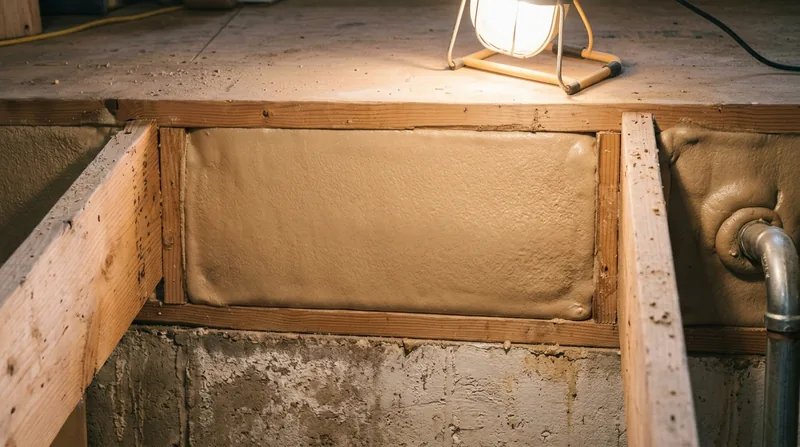




Denver's basement rim and band joists are where cold air sneaks in every winter, draining heat and driving up energy bills across the metro. The rim joist and band joist spray foam sealing we install stops that draft at the source, wrapping the band board in closed cell foam that hardens into an air barrier and thermal break. Homes in Park Hill, Wheat Ridge, Lakewood, and Arvada sit over basements that see temperature swings of 40 degrees or more between day and night during Colorado's cold snaps, and an uninsulated rim joist is an open door to the cold crawl space below. We spray closed cell foam along the rim and band in basements across Denver, Jefferson and Arapahoe counties to seal that gap for good. Call us at (720) 235-5710 for a free estimate, or learn more about our closed cell spray foam insulation services across the Denver metro.
Why Rim and Band Joist Sealing Matters in Denver Basements
The rim joist is the band of wood that sits on top of the foundation wall and carries the weight of the first floor. In Denver's older stock, brick bungalows in the Highlands and mid-century ranches across Englewood and Arapahoe County were built with minimal or no insulation around that band. Cold air from the unheated crawl space or basement flows upward through the rim, chilling the rim beam itself and the first-floor rim cavities above it. That cold radiates into the living spaces, and the temperature gradient pulls moisture and drafts through every crack and gap in the rim cavity. Winter heating bills spike, and the rim itself can reach 40 degrees when the outdoor air is 10 below. Closed cell spray foam stops that cold path dead.
- Rim joists in Denver basements lose heat continuously in winter because they sit between cold exterior soil and warm interior air, creating the highest temperature gradient in the home.
- Fiberglass batts or blown-in insulation in the rim cavity shift, settle, or leave air gaps that let cold air slip through to the first floor.
- Closed cell foam adheres to the rim board, band, and rim cavity in a single pass, filling every void and sealing out air infiltration permanently.
- A sealed rim joist also stops cold air from being drawn up into the first-floor rim cavities, which reduces draft complaints at exterior walls and basement windows.
Sealing the rim joist is one of the highest-return air sealing jobs in a Denver basement retrofit.
Key info: Denver's Front Range climate means winter lows routinely drop to single digits and below, and the rim joist is the path of least resistance for cold air to enter the home. A sealed rim and band can reduce first-floor heat loss by 10 to 15 percent in homes with open rim cavities, and the payback in comfort is immediate. See how this compares to our crawl space spray foam insulation work, which often goes hand in hand with rim joist sealing.
How We Seal Rim and Band Joists in Denver Basements
Our process starts with a site walk to assess the rim joist condition, the presence of existing insulation, and the accessibility from the basement or crawl space. We remove any loose fiberglass or debris from the rim cavity if needed, then set up mechanical ventilation to exhaust fumes during the spray. We spray closed cell foam in horizontal passes along the entire rim, building thickness in layers to meet the R-value and thermal barrier requirements for your city. The foam cures to a rigid shell that bonds to the rim board, band, and rim cavity, creating a continuous air barrier. We allow 24 to 48 hours before you re-enter the space, and the foam is then ready for any rim cavity framing or drywall closure your contractor may need.
- We inspect the rim joist for moisture, rot, or structural damage and stop work if we find conditions that need remediation before foam can be applied.
- We set up mechanical exhaust ventilation in the basement during spray and cure to manage VOC off-gassing and ensure air quality during the re-entry window.
- We spray closed cell foam in controlled passes, maintaining the manufacturer ratio and drum temperature to achieve uniform density and adhesion to the rim board.
- We specify the R-value and thickness of the foam application in writing so your builder or inspector knows exactly what was installed and why.
- We provide a re-entry window of 24 to 48 hours before the space is safe for normal occupancy, and we explain any lingering odor and ventilation steps you should take.
The entire job is completed in one day for most Denver basements, and the rim is sealed for the life of the home.
Example: A 1,200-square-foot ranch in Wheat Ridge with an uninsulated rim joist running 120 linear feet around the basement perimeter gets closed cell foam sprayed to 2 inches thick along the rim and band. The job takes one morning, costs from $650 and up depending on access and existing conditions, and reduces first-floor heat loss immediately. The homeowner notices warmer floors and fewer drafts at the rim the first winter after installation.
Rim and Band Joist Sealing Methods and Approaches
| Approach | Description | Best For |
|---|---|---|
| Closed Cell Rim Joist Foam | 1.5 to 2 inch closed cell spray foam applied to the rim board and rim cavity, curing to a rigid, moisture-resistant shell with R-value 6 to 6.5 per inch. | Denver basements in all climate zones, especially where moisture or rim cavity condensation is a concern; provides air sealing, thermal break, and moisture resistance in one pass. |
| Rim Cavity Fiberglass Retrofit | Fiberglass batts or blown-in cellulose installed in the rim cavity after the rim board is sealed with caulk or spray foam trim. | Budget-conscious retrofits where the rim cavity is accessible and open; does not provide air sealing by itself and requires careful installation to avoid air gaps. |
| Rim Joist and Crawl Space Foam | Closed cell foam applied to the entire rim joist, band, and rim cavity as part of a larger crawl space or basement encapsulation project. | Homes where the rim joist sealing is combined with crawl space spray foam, foundation wall foam, or basement rim cavity insulation; maximizes the air barrier and thermal envelope. |
| Rim Board Caulking and Tape | Polyurethane caulk or weatherstripping applied to the rim board seams, gaps, and penetrations without foam; a temporary or partial air seal. | Quick fixes or touch-ups on existing foam, sealing small gaps or rim board cracks; not a primary insulation method and does not provide R-value. |
Rim Joist and Band Joist Spray Foam Cost in Denver: What to Expect
Rim and band joist spray foam in Denver starts at around $650 for a basic single-story home with a 100 to 120 linear foot rim perimeter and good basement access. The cost rises with the total linear feet of rim, the thickness of foam required by your building code, and any obstacles like HVAC ducts, plumbing runs, or structural columns that require careful navigation. Homes in Lakewood, Arvada, and Highlands Ranch with larger footprints or finished basements may run $900 to $1,500 or more. A free on-site estimate lets us measure the rim, assess access, and give you a firm price before any work starts. We respond within 24 hours and can schedule spray work within one to two weeks depending on the season.
The biggest cost driver is the linear footage of rim joist to be sealed. A 1,500-square-foot ranch has roughly 140 linear feet of rim, while a 2,500-square-foot two-story home in Westminster or Thornton may have 160 to 180 linear feet. Accessibility also matters, if the basement is finished or cluttered, if plumbing or HVAC runs cross the rim, or if the rim board has rot or prior water damage that needs stabilization before foam can be applied. Getting two or three estimates from local contractors helps you understand the range and spot any red flags, such as an estimate with no R-value or thickness specified, or a price far below market with no inspection or warranty. See our full pricing overview for more detail on what moves the cost up or down.
Cost example: A 1,200-square-foot ranch in Englewood with a 120 linear foot rim, good basement access, and no structural obstacles costs from $750 to $900 for 2 inches of closed cell foam. A larger two-story home in Centennial with 160 linear feet and a finished basement or plumbing cross-runs might run $1,100 to $1,400. Quotes are always written with the R-value, thickness, and linear footage so you know exactly what you are paying for.
Rim Joist and Band Joist Spray Foam Near Me: What Denver Homeowners Should Know When Hiring
When you are looking for a spray foam insulation contractor to seal your rim joist in Denver, Aurora, Lakewood, or any of the surrounding towns, start by verifying that the contractor is fully insured and can provide a certificate of insurance. Ask for references from recent rim joist or basement insulation jobs in your area, and call at least two to ask about the quality of the installation, the professionalism of the crew, and whether any odor or curing issues arose. Request a written estimate that includes the R-value per inch, the total thickness in inches, the linear footage of rim to be sealed, and the re-entry window before the basement is safe to occupy. Verify that the contractor understands the thermal barrier and ignition barrier rules that apply at your address, because the code in Denver, Boulder, and Arapahoe County differ, and the building official has the final say. If you have an HOA, check whether any exterior work or crawl space access requires architectural approval before you book the job.
- A reputable spray foam contractor will provide a free estimate within 24 hours and will measure the rim joist in person before quoting.
- The estimate should specify the type of foam (closed cell or open cell), the R-value per inch, the total thickness, and the cost per linear foot or total job price.
- The contractor should explain the mechanical ventilation plan during spray and cure, and the re-entry window before you can safely use the basement.
- References from recent jobs in Denver or the surrounding area are the best way to verify quality and professionalism.
- Avoid contractors who promise immediate re-entry, who skip mechanical ventilation during cure, or who quote a price with no R-value or thickness specified.
- Verify that the contractor understands your local building code and will help you navigate any permit requirements or HOA approvals that apply to your home.
Call us at (720) 235-5710 to schedule your free rim joist estimate, or visit our contact page to get started.
Rim Joist & Band Joist Spray Foam in Denver: Pricing Guide
| Service | Price | Details |
|---|---|---|
| Rim Joist Sealing, Single-Story Home | Starting at $650 | 100 to 120 linear feet of rim with good basement access and no structural obstacles or prior damage |
| Rim Joist Sealing, Two-Story Home | Starting at $950 | 140 to 180 linear feet of rim, finished basement, or plumbing and HVAC cross-runs requiring careful navigation |
| Rim Joist with Crawl Space Foam | Starting at $1,200 | Rim joist sealing combined with crawl space spray foam or foundation wall insulation as part of a larger basement retrofit |
| Complex or Large-Scale Job | On estimate | Homes with extensive rim cavity damage, large footprints over 2,500 square feet, or tight basement access requiring special equipment |
| Travel | Included | No separate call-out fee or mileage charge within Denver and surrounding service areas across Jefferson and Arapahoe counties |
| Estimate | Free | Response within 24 hours at (720) 235-5710, on-site measurement and assessment included, no obligation to book |
Indicative pricing, the exact cost depends on square footage, finish, and site access. Free personalized estimate within 24h at (720) 235-5710.


