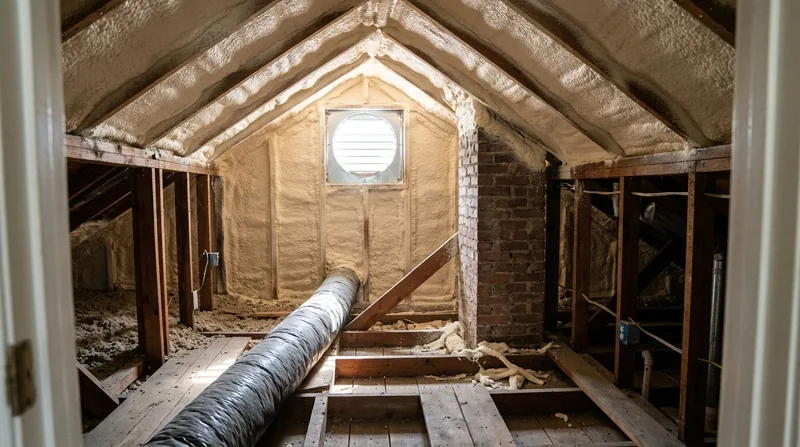




Denver attics bake under strong Front Range sun before cooling fast once it drops behind the mountains, a swing that stresses roof decks and top plates alike. Most homes across the metro, from brick bungalows in the Highlands and Park Hill to mid-century ranches in Wheat Ridge, Arvada, and Lakewood, sit over basements with vented attics that lose heat all winter and gain it all summer. Attic spray foam insulation in Denver stops that cycle by sealing the attic undersides and roof decks where air leaks and heat transfer happen fastest. We insulate attic undersides and roof decks across Denver County, Jefferson County, and Adams County to keep your heating and cooling bills from swinging as wide as the temperature outside. This work is not a weekend project, and it is not a commodity. The difference between a sound installation and a failed one shows up in your utility bills, your indoor comfort, and your ability to reach someone when a question arises six months later.
Why Attic Insulation Matters in Denver's Climate
Denver sits in climate zone 5B, which means cold winters, warm summers, and wide day-to-night temperature swings that stress building envelopes relentlessly. The real driver of energy loss here is not humidity or mold risk, as it is in humid climates, but air leakage and thermal bridging. Uninsulated rim and band joists in basements, old attic insulation that has settled flat in brick bungalows, and leaky top plates and roof penetrations in ranches all bleed conditioned air. Once that air escapes through the attic, your HVAC system runs harder to replace it, and your bills climb month after month. Spray foam seals those gaps and adds R-value at the same time, which is why it outperforms fiberglass batts and blown-in cellulose in this climate.
- Stops air leakage at roof penetrations, top plates, and rim joists where fiberglass cannot seal.
- Adds R-value while sealing, so one application handles both insulation and air sealing.
- Protects against the wide temperature swings that cause convective air currents in vented attics.
- Works in both new construction and retrofit applications across Denver County and Jefferson County.
These factors combine to make attic spray foam the highest-impact insulation upgrade for most Denver homes.
Key info: Denver building code requires a thermal barrier between foam and interior living space in attics, and a fifteen-minute ignition barrier in many jurisdictions. Verify your local requirements with the building department at your address before any work begins. The Denver Building Department and city offices across Adams County, Jefferson County, and Arapahoe County each maintain their own rules, and there is no reciprocity between them.
For more on how air sealing works alongside foam insulation, see our air sealing service page.
How We Insulate Attics in Denver: Our Process
We start with an on-site assessment to measure the attic space, identify air leaks, and determine the existing insulation type and depth. Many Denver homes built before 1990 have blown-in cellulose or fiberglass that has settled to R-3 or R-4 in the worst spots, leaving most of the attic undersides exposed. We photograph the existing condition, calculate the board feet needed to reach your target R-value, and provide a written estimate with thickness and R-value specs. Once you approve, we schedule the work, set up mechanical ventilation to manage off-gassing during cure, and spray the foam in controlled passes to ensure proper density and thickness. The foam cures in twenty-four to forty-eight hours, after which the attic is ready for normal use.
- We perform a site visit to measure the attic space and assess existing insulation depth and condition.
- We calculate board footage and R-value needed to meet your heating and cooling goals.
- We provide a written estimate that names the foam type, R-value, and thickness per pass.
- We set up mechanical ventilation during application to manage cure off-gassing safely.
- We allow a twenty-four to forty-eight hour cure window before re-entry into the attic space.
This methodical approach ensures the foam is applied at the correct thickness and density, which is the only way to deliver the R-value and air sealing you paid for.
Local example: A 1950s ranch in Wheat Ridge with a vented attic and settled fiberglass typically needs twelve to fourteen inches of closed cell foam to reach R-50 at the roof deck. An open cell application in the same attic would require eighteen to twenty-four inches to hit the same R-value. We assess your attic and recommend the foam type that makes the most sense for your budget and long-term goals.
See how closed cell spray foam and open cell spray foam differ in performance and cost.
Attic Spray Foam Insulation Methods
| Method | Description | Best For |
|---|---|---|
| Closed Cell Spray Foam | High-density foam that reaches R-6 to R-7 per inch, seals air gaps, and resists moisture. Applied in thin passes to avoid thermal stress on roof decks. | Sealed, unvented roof decks; attics where space is tight and R-value per inch matters; retrofit over old fiberglass. |
| Open Cell Spray Foam | Lower-density foam at R-3.5 to R-3.8 per inch, cost-effective, allows vapor permeability, and absorbs sound. Requires more thickness to reach high R-values. | Vented attics where moisture is not a concern; budget-conscious retrofits; sound dampening in conditioned attics. |
| Removal and Re-Foam | Complete removal of failed, settled, or contaminated old insulation before new foam is applied. Includes disposal and site cleanup. | Attics with degraded fiberglass, cellulose, or prior foam that has failed; new construction framing cleanup. |
| Sealed Roof Deck Installation | Spray foam applied directly to the underside of roof sheathing to create an unvented attic and conditioned space. Requires careful attention to ductwork and mechanical systems in the attic. | New construction and major renovations where HVAC ducts and equipment live in the attic; high-performance homes. |
Attic Spray Foam Insulation Cost in Denver: What to Expect
Attic spray foam insulation in Denver typically starts at $1.50 per square foot for open cell applications in straightforward vented attics. Closed cell spray foam, which delivers higher R-value per inch and seals moisture better, runs higher, usually $2.50 to $4.00 per square foot depending on thickness and access. A 1,500-square-foot attic in a Denver bungalow with settled fiberglass and good attic access might cost $2,250 to $6,000 in total labor and material for a closed cell retrofit to R-50. A 2,000-square-foot attic in a Highlands Ranch ranch home with multiple roof penetrations, knee walls, and tight eaves could run $3,000 to $8,000. The price moves up when access is poor, when old insulation must be removed first, when the attic has complex geometry or multiple roof lines, or when you choose closed cell over open cell.
We recommend getting two or three written estimates from contractors in your area before committing. A solid estimate will name the foam type, the R-value you will achieve, the thickness per pass, the total board feet, and the labor and material cost. If an estimate omits these details or quotes a price far below market with no explanation, walk away. Spray foam is a material and technique, and the cheapest bid often means corners cut on curing time, ventilation, or application density.
Visit our full pricing overview to see cost ranges for other services and to understand how factors like attic size, foam type, and removal work into your final quote.
Attic Spray Foam Insulation Near Me: What Denver Homeowners Should Know When Hiring
Hiring the right spray foam contractor matters more than price alone. The spray foam trade has two extremes: rig-and-run crews who arrive in an out-of-state trailer, spray an attic in an afternoon, and disappear when the smell will not go away or the foam shrinks; and national franchises whose local crews may have little accountability. The local independent shop, held to the same standard by word-of-mouth and reputation, is often the safer bet. Verify that any contractor you consider carries full insurance and can provide a certificate of insurance naming your address. Ask for references from jobs in your neighborhood, and call at least two to ask about cure time, ventilation during application, and whether the contractor was reachable after the job for questions.
Understand your local permitting requirements before you hire. Denver, Aurora, Lakewood, Arvada, Thornton, and other cities in the metro each maintain their own building codes and permit processes. Some attic insulation work requires a permit, and some does not, depending on your city and the scope of work. If your attic includes existing ductwork or HVAC equipment, permitting may be required. Ask the contractor whether a permit applies at your address, and ask the building department yourself if you have doubts. If your home is in an HOA, check the architectural guidelines for any restrictions on exterior work or roof-line modifications.
- Request a written estimate that specifies foam type, R-value, thickness per pass, board footage, and total cost.
- Verify that the contractor carries full insurance and can provide proof of coverage before work begins.
- Call at least two references from recent jobs in Denver or nearby to ask about the application process and post-job service.
- Confirm with the building department whether a permit is required for your attic work at your address.
- Check any HOA rules for restrictions on exterior or roof-line modifications before scheduling.
These steps take one or two hours and will save you thousands in regret if something goes wrong.
Ready to get started? Contact us for a free estimate at (720) 235-5710. We serve Denver, Aurora, Lakewood, Arvada, Westminster, Thornton, Centennial, Highlands Ranch, Boulder, Longmont, Englewood, Wheat Ridge, Parker, Castle Rock, Littleton, Broomfield, Commerce City, Northglenn, Golden, and Greenwood Village.
Attic Spray Foam Insulation in Denver: Pricing Guide
| Service | Price | Details |
|---|---|---|
| Open Cell Spray Foam Attic | Starting at $1.50/sq ft | Includes application, mechanical ventilation during cure, and written R-value spec. Cost moves up with attic size and removal work needed. |
| Closed Cell Spray Foam Attic | Starting at $2.50/sq ft | Higher R-value per inch, moisture resistance, and superior air sealing. Price varies by thickness required and access difficulty in Denver attics. |
| Removal and Re-Insulation | On estimate | Removal cost depends on attic size, insulation type, and disposal logistics. We assess on site and provide a combined removal and foam application price. |
| Sealed Roof Deck Installation | On estimate | Unvented attic work is more complex and requires careful attention to existing ductwork and mechanical systems. On-site assessment required. |
| Travel and Mobilization | Included | No separate mileage or travel fee for Denver and surrounding areas across Denver, Jefferson, and Adams counties. |
| Free Estimate | No obligation | Call (720) 235-5710 for a site visit. We respond within 24 hours with a written estimate and R-value specification. |
Indicative pricing, the exact cost depends on square footage, finish, and site access. Free personalized estimate within 24h at (720) 235-5710.


