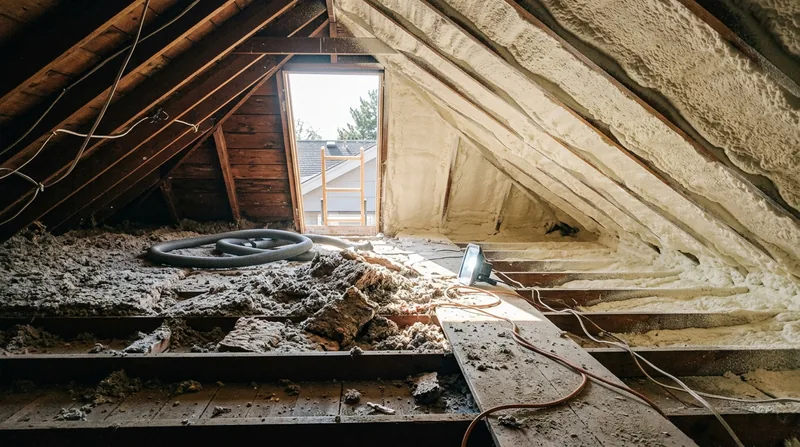




Denver's older brick bungalows, Park Hill squares, and mid-century ranches across Wheat Ridge, Arvada, and Lakewood sit under vented attics that bake in the Front Range sun and cool fast once it drops. That temperature swing, combined with cold winters and low humidity, drives heat loss through the roof deck and air leakage around top plates and rim joists. Most of these homes came with fiberglass batts or blown-in insulation that has settled flat over decades, leaving gaps where warm air escapes in winter and cool air leaks out in summer. Insulation Replacement & Re-Insulation in Denver means pulling out that failed material and installing new insulation or spray foam that actually seals the envelope. We help homeowners across Denver, Boulder, and Jefferson County replace old insulation with systems that hold their R-value and stop the drafts that drive energy bills higher every year.
Why Insulation Replacement Matters in Denver's Older Homes
Settled fiberglass and deteriorated blown-in insulation are the dominant failure modes in Denver's residential stock. A brick bungalow in the Highlands or a ranch in Wheat Ridge built in the 1950s or 1960s often has insulation that has compressed to half its original thickness, especially in attics where foot traffic, settling, and moisture have taken their toll. Once insulation loses its loft, it loses its R-value. Heat moves through flat insulation almost as fast as through air, and the cold snaps and chinook winds of Colorado's 5B climate push air through every gap in an older wall cavity. The cost of leaving that problem alone is measurable: higher heating and cooling bills, cold spots in winter, uneven temperatures from room to room, and strain on HVAC equipment running longer to compensate.
- Settled attic insulation loses R-value and allows warm air to escape through the roof deck in winter.
- Gaps around top plates, penetrations, and rim joists are the path for drafts that no amount of fiberglass can seal.
- Old insulation often sits directly on drywall without an air barrier, allowing convective air movement even if the material is intact.
- Replacement with spray foam or new blown-in material stops both heat loss and air leakage in a single pass.
- Energy bills drop measurably once the envelope is sealed, and indoor comfort becomes consistent across the house.
Replacing failed insulation is not optional in Denver's climate; it is the foundation of any energy-efficient home. For detailed guidance on what to expect from a professional replacement, see our attic spray foam insulation service.
Denver example: A 1,600-square-foot ranch in Lakewood with R-19 batts settled to R-8 in the attic will lose roughly 40 percent more heat through the roof than design specs. Replacing that insulation with 6 inches of open cell spray foam (R-22) plus air sealing around the top plate and rim joists typically cuts heating costs by 15 to 25 percent on that home.
Colorado's Division of Local Affairs publishes residential energy code requirements by county, and your local building department will specify the R-value required for your address. We help you understand what applies to your home and what the replacement will deliver.
How We Remove Old Insulation and Install New Coverage
Insulation replacement starts with assessment and removal. We inspect the existing material to identify what is there, check for moisture or contamination, and plan the safest way to extract it. Once the space is cleared, we measure the area and calculate the board footage needed for the new system. Installation depends on what you choose: blown-in fiberglass or cellulose for attics, spray foam for attics or sealed roof decks, injection foam for closed walls, or foam for crawl spaces and rim joists. Each method has a different technique, cure time, and cost profile. We work to the R-value and thickness your home needs, confirmed in a written estimate before work begins.
- We assess existing insulation and remove failed or settled material safely, bagging and hauling it to a licensed disposal facility.
- We seal air leaks around top plates, penetrations, and rim joists before installing new insulation.
- We install new insulation to the R-value and thickness specified in your estimate, verified on site.
- We provide a written summary of the work completed, including R-value, material type, and coverage area.
The entire process from estimate to completion typically takes 1 to 3 days, depending on the size of the space and the method chosen. For removal of old insulation and detailed explanation of that step, visit our insulation removal service page.
Highlands Ranch example: A 1,200-square-foot attic with R-19 batts and no air sealing gets a full removal, then 5.5 inches of closed cell spray foam (R-38) applied to the roof deck, plus air sealing around the top plate and ductwork penetrations. The job takes 2 days: removal on day one, foam application and cure on day two. Cost starts at $4,200 on estimate.
Insulation Replacement Methods and When to Use Each
| Approach | Description | Best for |
|---|---|---|
| Blown-in fiberglass or cellulose | Loose-fill material blown into attics or walls to a specified R-value; no cure time needed. | Vented attics where air sealing is minimal; cost-sensitive jobs; retrofit of existing cavities. |
| Open cell spray foam | Lightweight foam applied to the underside of roof decks or walls; R-3.6 per inch; breathable and moisture-permeable. | Vented attics; sound dampening in garages; attics where vapor movement is not a concern; Denver's dry climate. |
| Closed cell spray foam | Dense foam applied to roof decks, walls, or crawl spaces; R-6 to R-7 per inch; creates an air and moisture barrier. | Sealed or unvented attics; crawl spaces; rim joists; metal buildings; condensation control on steel. |
| Injection foam into closed walls | Low-pressure foam injected into wall cavities through small holes; minimal demolition; R-3.5 to R-4.5 per inch. | Retrofit of pre-1980 homes in Denver, Arvada, and Wheat Ridge; walls that cannot be opened; existing homes without gut renovation. |
The choice between these methods depends on your attic or wall configuration, your R-value target, and your budget. We recommend the method that delivers the best performance for your home's climate zone and use case, not necessarily the cheapest option. If blown-in is the right answer for a simple top-up of a sound attic, we say so.
Insulation Replacement & Re-Insulation Cost in Denver: What to Expect
Insulation replacement costs in Denver depend on the size of the space, the material chosen, the R-value required, and the condition of the existing insulation. A simple attic top-up with blown-in material costs less than a full removal and spray foam installation. A crawl space or rim joist project is smaller in square footage but often requires more labor per board foot because of access and air sealing work. A sealed attic retrofit with closed cell foam is a larger investment but delivers higher R-value in less thickness and creates a true air and moisture barrier.
Most attic replacement jobs in Denver start at $2,800 to $3,500 for smaller homes and rise to $5,000 to $8,000 or more for larger attics or jobs that include rim joists and crawl space work. The variables that move the price are square footage, R-value target, removal complexity, and whether air sealing is included. A 1,200-square-foot attic with settled R-19 batts replaced with 5.5 inches of closed cell foam (R-38) typically costs $4,000 to $4,800 on estimate. A 2,000-square-foot attic with the same scope might run $6,500 to $7,500. Removal of old insulation adds $800 to $1,500 depending on volume and disposal.
Getting 2 to 3 estimates is the best way to understand the true cost in your neighborhood. Each estimate should include the R-value, material type, thickness, square footage, and a breakdown of labor and materials. Avoid any estimate that omits R-value or thickness specifications; that is a red flag. For a detailed pricing overview and to request a free estimate, visit our pricing page or call (720) 235-5710.
What to Look for When Hiring an Insulation Replacement Contractor Near Denver
Choosing the right contractor for insulation replacement is as important as choosing the material. The market includes local, independent shops, regional franchises, and out-of-state rig-and-run crews. The local independent is positioned to offer honest guidance and accountability; you can reach us if a problem arises. A professional estimate includes R-value, thickness, and material type in writing. Multiple estimates let you compare apples to apples and spot outliers. References from past jobs in Denver, Arvada, or Lakewood tell you whether the work holds up over time. Insurance and bonding protect you if something goes wrong. Permits vary by city, and a contractor who understands the rules for your address is a sign of experience.
- Verify that any contractor you hire is fully insured and can provide a current certificate of insurance on request.
- Get written estimates from at least two contractors that include R-value, thickness, material type, and total cost.
- Ask for references from jobs completed in the past two years in your neighborhood or similar homes.
- Check whether permits are required for your address and whether the contractor will help you navigate the local building department.
- Understand the re-entry window and cure time for spray foam; reputable installers recommend 24 to 48 hours before occupancy.
- Avoid estimates with no R-value specification, prices far below market, or promises of immediate re-entry after foam application.
The honest position of a professional contractor is that correct installation matters more than material choice alone. Controlled thickness per pass, proper drum temperature, mechanical ventilation during cure, and a stated re-entry window are the marks of quality work. If you have questions about what to expect or want to verify our qualifications, contact us for a free estimate.
Insulation Replacement & Re-Insulation in Denver: Pricing Guide
| Service | Price | Details |
|---|---|---|
| Attic top-up with blown-in insulation | Starting at $2,800 | Includes removal of old settled material, cleanup, and blown-in fiberglass or cellulose to R-38 or R-49 depending on existing coverage and climate zone requirements |
| Attic replacement with open cell spray foam | Starting at $3,600 | Removal of old insulation, air sealing of top plate and penetrations, open cell foam to R-22 to R-25, and mechanical ventilation during cure; best for vented attics in Denver's dry climate |
| Sealed attic retrofit with closed cell spray foam | Starting at $4,800 | Full removal of old insulation, air sealing, closed cell foam to R-38 to R-43, and optional ductwork encapsulation; includes rim joist and band joist sealing; larger investment with highest R-value per inch |
| Crawl space and rim joist spray foam | Starting at $3,200 | Access-dependent; includes inspection, rim joist sealing with closed cell foam, and rim board encapsulation; cost moves with linear footage and crawl space height |
| Complex multi-zone job or full home envelope | On estimate | Attic plus crawl space plus walls or sealed roof deck retrofit requires on-site measurement and assessment before pricing; typically $8,000 to $15,000 or more depending on home size and scope |
| Free estimate and site inspection | No charge | Response within 24 hours; includes measurement, material recommendation, R-value specification, and written quote; no obligation to book |
Indicative pricing, the exact cost depends on square footage, finish, and site access. Free personalized estimate within 24h at (720) 235-5710.


