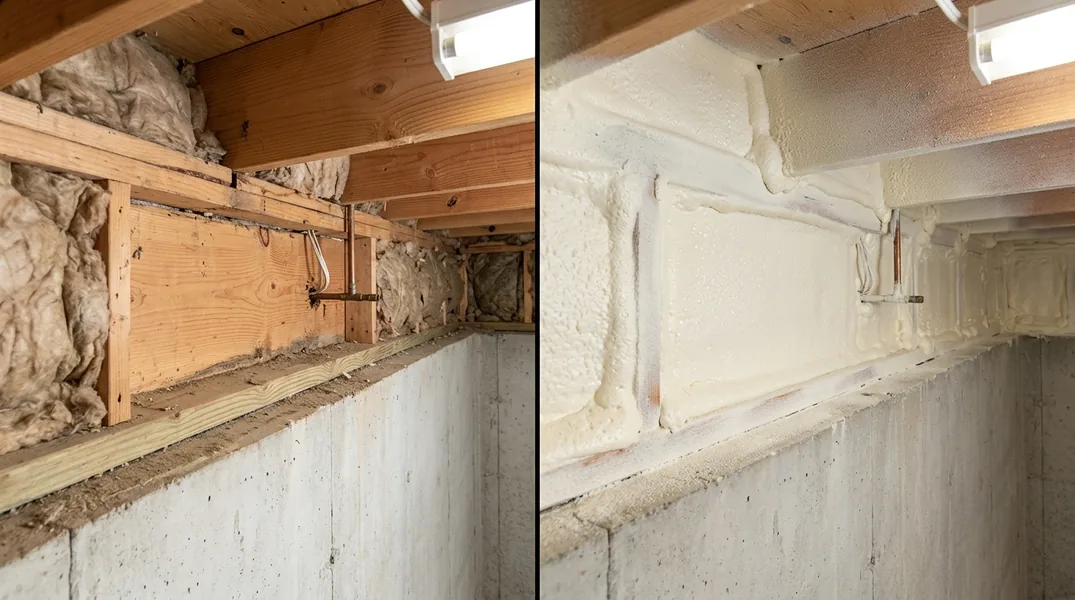
Why Basements and Rim Joists Are Energy Thieves in Denver Homes
Most homeowners in Denver focus their energy-saving efforts on the attic. It makes sense: warm air rises, and an uninsulated attic is an obvious culprit for heat loss. But while you're thinking about your attic, your basement and rim joists are quietly draining your heating and cooling budget.
The rim joist is the band of wood that sits on top of your foundation, connecting the basement to the walls above. It's one of the most overlooked thermal weak points in residential construction. Unlike your attic, which is at least somewhat visible and accessible, rim joists hide behind walls and are easy to forget about. Yet they're exposed to outdoor temperatures on multiple sides and are frequently left completely uninsulated or filled with old, deteriorating materials. Combined with basement walls that are often poorly insulated or not insulated at all, these areas can account for 10 to 20 percent of your home's total heat loss.
In Denver's climate, where winter temperatures routinely dip below freezing and summer heat demands air conditioning, the cost of ignoring these spaces adds up quickly. If you've never had a professional energy audit or inspection of your basement and rim joists, there's a good chance you're losing hundreds of dollars per year to preventable energy waste.
Understanding Old Insulation and When Removal Becomes Necessary
Many Denver homes, especially those built before the 1990s, contain outdated insulation materials that have lost their effectiveness over time. Old insulation removal is often the first step toward creating a truly efficient basement or rim joist system. Some homes contain vermiculite insulation, a loose-fill material that was commonly used in attics and wall cavities. While vermiculite itself isn't inherently dangerous in all cases, it can settle and compact over decades, reducing its R-value significantly. Additionally, older fiberglass batts in basements frequently absorb moisture, which destroys their insulating properties and can promote mold growth.
The question isn't whether your old insulation works anymore, but rather how much energy you're wasting by keeping it. Insulation removal cost concerns often hold homeowners back from upgrading, but the long-term savings in energy bills typically justify the investment within five to ten years. When you remove degraded insulation, you also get a chance to inspect the underlying structure for moisture damage, air leaks, and other issues that might otherwise go unnoticed. This is especially important in basements, where moisture intrusion is a common problem in the Denver area.
If your home has attic insulation removal needs, those same principles apply to your basement and rim joists. The sooner you address deteriorated insulation, the sooner you stop paying to heat and cool the outdoors instead of your living space.
Closed Cell Spray Foam: The Superior Solution for Basements and Rim Joists
Closed Cell Spray Foam Insulation is the gold standard for basement and rim joist applications. Unlike traditional fiberglass or cellulose, closed cell foam provides an R-value of approximately 6 to 7 per inch, meaning you get superior insulation in a thinner application. This matters tremendously in rim joists, where space is limited and you can't afford to lose interior square footage.
Closed cell foam also serves as an air barrier and vapor retarder, sealing every crack, gap, and penetration. Basements and rim joists are notorious for air leaks, especially around rim joist perimeters, band boards, and rim joist-to-foundation connections. These tiny openings allow conditioned air to escape and unconditioned air to infiltrate, creating drafts and temperature inconsistencies. Spray foam eliminates these leaks entirely, creating a tight thermal envelope that keeps your basement warmer in winter and cooler in summer.
Another critical advantage: closed cell foam resists moisture absorption. In Denver's semi-arid climate, moisture isn't usually the problem it is in more humid regions, but basements can still develop damp spots, especially near the foundation perimeter or after heavy snowmelt. Closed cell foam won't degrade in these conditions and actually helps prevent moisture from entering the insulation cavity in the first place.
The Insulation Removal Process: What to Expect
Before spray foam can go in, old insulation must come out safely and responsibly. Insulation removal is more involved than simply tossing old batts into a dumpster. Professional removal teams use specialized equipment, containment procedures, and proper disposal methods to ensure no contamination occurs inside your home.
The first step is assessment. A technician will inspect your basement and rim joists to identify what type of insulation is present, its condition, and any potential hazards. If vermiculite or asbestos-containing materials are suspected, samples may be tested before removal begins. Once the scope is clear, the removal crew will seal off the work area, use negative air pressure equipment to prevent dust and debris from spreading throughout your home, and carefully remove all old insulation. The exposed cavities are then cleaned and inspected for moisture damage, mold, or structural issues.
The entire process typically takes one to three days, depending on the size of the area and the amount of insulation to be removed. While attic insulation removal costs vary based on square footage and material type, basement and rim joist removal is usually priced similarly. Getting a free estimate from Denver Spray Foam Insulation will give you a clear picture of what to expect in terms of timeline and budget.
Spray Foam Installation in Basements and Rim Joists Near Me: Why Professional Application Matters
Once old insulation is removed, the real transformation begins with professional spray foam application. Closed Cell Spray Foam Insulation requires specialized equipment, training, and experience to install correctly. The foam is sprayed as a liquid that expands and hardens within seconds, filling every cavity, corner, and gap. If applied improperly, you'll end up with voids, uneven coverage, or an incomplete air seal that defeats the purpose.
Professional installers understand how to account for expansion rates, surface temperatures, humidity levels, and ventilation requirements specific to basements and rim joists. They know how to work around electrical wiring, plumbing, and HVAC ducts without creating fire hazards or blocking necessary access. They also apply the correct thickness to achieve your target R-value and ensure the foam cures properly before you occupy the space.
For homeowners in Denver and surrounding areas, choosing a local contractor with deep experience in the region's climate and building codes is essential. Denver Spray Foam Insulation has the expertise to handle your basement and rim joist project from start to finish, ensuring your investment delivers maximum energy savings and comfort. Call (720) 235-5710 today to discuss your specific situation.
Energy Savings and Long-Term Return on Investment
The financial case for upgrading your basement and rim joist insulation is compelling. A typical homeowner can expect to reduce their annual heating and cooling costs by 10 to 15 percent once basements and rim joists are properly sealed and insulated. In Denver, where heating costs are substantial during winter months, this translates to savings of several hundred dollars per year for many households.
When you factor in increased comfort, improved indoor air quality from reduced infiltration, and the potential for lower insurance premiums in some cases, the return on investment becomes even stronger. Plus, an energy-efficient home is more attractive to future buyers if you ever decide to sell. The improvements you make to your basement and rim joists are permanent upgrades that add tangible value to your property.
Don't let another heating season slip by while your basement and rim joists leak energy. Contact Denver Spray Foam Insulation for a free estimate and discover how much you could save. Whether you need attic insulation removal or basement upgrades, our team is ready to help you create a more efficient, comfortable home.
Looking for a professional spray foam insulation contractor in Denver? Denver Spray Foam Insulation responds fast for all your spray foam insulation needs.
Get a Free Quote